 FEATUREFEATURE
Todd Rundgren wants to change the way you think about music - now that he's gotten the bugs worked out of it.
"It's still kind of in a holding pattern, but it's looking pretty good. We had some fits and starts in the beginning mostly because of server conflicts," he said from his hotel room in Chicago.
The 49-year-old rock musician, production wunderkind and pioneer in numerous fields, was talking about PatroNet, a revoutionary new system in which users would pay an annual subscription fee to an artist. That fee would help the artist underwrite the costs of creating new music, and would give the user access to new songs as they are created, chat rooms and Webcast events, among other things.
|
"We did get the [initial] interest [in PatroNet], and then I discovered I was getting myself into a customer service bind because I was dealing with problems that weren't necessarily mine," said Rundgren, who included incompatability with common Web browsers as an occasional problem. "I eventually got set up and decided to just put everything on hold and deal with [the issues].
"My solution was to come up with a tuner of my own that will allow me and everyone else to get connected and give everybody access to the content they want, but won't have the huge overhead of a browser per se, and it will guarantee the delivery of all the media."
|
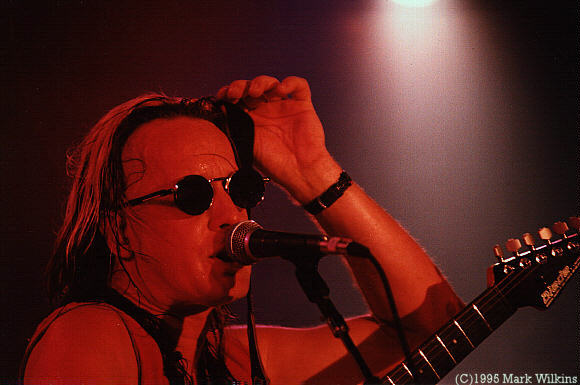
Todd onstage in Memphis during The Individualist tour. Photo ©1995 Mark Wilkins. |
But while the annual subscription fee would help an artist underwrite the cost of performing their craft, Rundgren says he's not out to replace the CD.
"The CD is a sound delivery format, and that's not what PatroNet is involved in, per se," he said. "PatroNet is there simply to help creators and their audiences get connected, and give somebody who has something that can be digitally delivered the necessary mechanisms to do so without re-inventing the wheel.
"Mostly, it's supposed to be invisible to the people who use it. If it's doing its job properly, [customers] aren't even aware it's there. And once the creative entity gets set up and rolling, they don't have much interaction with PatroNet unless something goes wrong.
"I think it's very much like a shareware concept in that when you buy a piece of shareware and pay the registration fee for it, you get, usually, a certain term of updates to go with it. So, you really have gotten into more of a relationship than simply a product transaction. That's kind of the unique difference of the Web and what the Web can bring to this commerce between artists and their audience; it's to defocus the idea of the disc being the ultimate product and focus it more on the relationship being what you're offering people."
While Rundgren is serving as the beta tester for his creation, he said PatroNet could benefit both the established artist and the up-and-coming band.
"I think an established artist has an advantage in that they have a certain audience they can depend on and get right into the business of being underwritten directly by that core audience," he said. "But, new artists, I think - if they're not in too much of a hurry and want to do the same kind of work they have to do in the regular world to establish and break themselves - there's no reason why people can't build an audience from scratch the same way. You have to give stuff away before you can charge for it.
"It's the same thing a record company will do. They will underwrite a new act until they can actually sell enough records to pay for themselves."
Besides promoting PatroNet and serving as the CEO of Waking Dreams, Inc., a company formed to help turn concepts into marketable items, Rundgren is touring in support of With A Twist, a collection of his best-known hits done in a bossa-nova style.
"I had the bossa-nova idea first, and that's because I was being courted by a Latin American publishing entity," he said. "I started to realize the Latin American market was somewhat significant. I hadn't made any definite plans, but I was musing about what I might do if I wanted to introduce myself to that market.
"So, I started toying with the idea of doing songs in a bossanova style, though I thought that many of them would be new songs.When I got approached by Guardian Records, and they wanted me to do all of my older material, I kind of used it as an opportunity to merge the two ideas. And since it gets worldwide release anyway, I'll get to find out whether the South American market has any interest in my style of bossa-nova."
The overall critical response to the disc has been favorable, and Rundgren said the long-time fans not only are enjoying it, but are seeing this as a natural progression for an artist who has been known to be eccentric in his output.
"Everybody seems to be enjoying it . In one sense, it's what people have been asking for for a long time, all those songs that I usually don't play, or I might only play one or two of during the course of a tour. The show has a bit of a theatrical element, which makes it more fun for people, I think. Overall, I think it's pretty well-packaged, so people will have less to complain about."
Rundgren first drew attention as the guitarist for The Nazz in the late Sixties. Since then, Rundgren has become well known for his studio releases, both as a solo artist (Something / Anything?, Hermit Of Mink Hollow, A Capella) and with the progressive-rock band Utopia. In addition, Rundgren has become one of the most respected producers in rock, working with such artists as Meat Loaf (Bat Out Of Hell), Badfinger (Straight Up), XTC (Skylarking) and Grand Funk (We're An American Band).
But for all of his hard work in the studio, Rundgren has only tasted chart success occasionally, most notably with "I Saw The Light" and "Hello, It's Me" off Something / Anything?, and in the Eighties with "Bang The Drum All Day" off The Ever Popular Tortured Artist Effect.
"People are only aware of what gets aggressively marketed to them in the modern music business milieu," said Rundgren. "It's one of those things that as you get older - when my big hits, like the songs off of Something / Anything? came out, I was in my early twenties, and that is pretty much the time when most artists have their success. As time goes on, people do tend to think they know what you're about, and the music business, and the demographic that buys records, are interested in artists of their own age and things they perceive to be new.
"One of the reasons I got the PatroNet idea was that the standard record industry and all the associated media that goes with it aren't much interested in artists that have been around too long, regardless of what you're doing. I think at least through the Web and aggressively taken on these Web issues has actually raised my visibility to an audience that's important to me. That trend of people kind of writing you off or assuming what you are can be, with some great deal of effort, affected or reversed by using the new mechanism of Web activity."
Rundgren is a pioneer of the music video age - he was the second artist broadcast on MTV in its birth cries. He has also developed graphics tablets used by Apple Computer, and is fluent in numerous programming languages and applications. In 1993, Rundgren released No World Order, the first interactive music-only disc, which allowed listeners to shape the music in any version they chose.
With such a vast history of work in his past, one would think that Rundgren would have a favorite album. Think again.
"The problem with that is that I'm well over thirty albums' worth of stuff," he said. "Although there are a few albums that I'm fairly happy with, and productions as well, it's one of those things that I don't really ponder on in the way that other people might. I'm too involved in what I have yet to do. Some people identify so heavily with these artifacts of themselves that they do have favorites because they think it puts them in a good light. For me, it's all part of the process."
So what does Rundgren consider himself, to paraphrase the title of one of his albums - A Wizard, or A True Star?
"Well, I could take the Fifth, but I'd have to say it's more on the Wizard side," he said, laughing. "There's always been things I've been unwilling to do in order to gain popularity or remain popular."
Thanks to Steve Cox for permission to reprint the photo from his Web site.
Special thanks to Kelli Richards at Waking Dreams for her assistance in arranging this interview.
© 1997 Robert Pierce. All rights reserved. This work may not be reprinted or reproduced without the permission of the author.
Reproduced with kind permission of the author